The fear of the LORD is the beginning of the wisdom

నిస్సి చానల్ మీపిల్లల ఉజ్వల భవిష్యత్తుకు
Rc. No. 1417/C3/2023
Recognized by The Government of Andhrapradesh
UDISE CODE 28234201052

Nutrition
Class 10
Important Questions and answers
1. Answer the following questions by observing the diagram showing the experiment:

a) What will you prove by this experiment?
By this experiment we will going to prove oxygen is released during photosynthesis.
b) What apparatus do you use in this experiment?
-
Beaker
-
Test-tube
-
Funnel
-
Hydrilla Plant
-
Burning splinter.
c) What would be the results if the experiment is done in shadow?
If we conduct this experiment in shadow no change in the water level of the Test-tube. No photosynthesis occur. No air bubbles are form.
d) What will you do to obtain result from the experiment?
If the burning splinter is kept near the mouth of test tube, burns brightly.
2. Answer the following questions by observing the diagram showing the experiment:

a) What will you prove by this experiment?
Carbon dioxide (CO2) is necessary for the photosynthesis.
b) What apparatus do you use in this experiment?
Wide mouthed bottle, split cork, KOH solution, Iodine, Potted plant.
c) Why do we use KOH solution in this experiment?
KOH is used for the absorption of CO2 in the bottle.
d) Why did we study two leaves in this experiment?
We should test two leaves of which one must be having the availability of CO2 and other must not be having the availability of CO2 to prove that CO2 is essential for photosynthesis.
e) Which solution is taken in the bottle?
Potassium hydroxide / KOH solution.
f) After iodine test, The part of the leaf inside the bottle did not turn into blue, black color why?
Absence of carbondioxide.
g) Where do we keep the plant before experiment?
Plant has to be kept in dark.
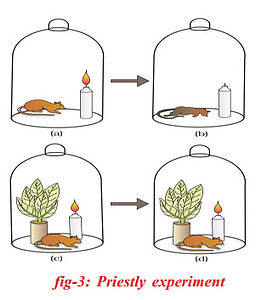
3. Write the experiment of bell jar and pudina plant, performed by Priestley to prove that air plays key role in Photosynthesis.
-
Joseph Priestley in 1770 performed a series of experiments that revealed the essential role of air in the growth of green plants.
-
Priestley discovered oxygen in 1774.
-
Priestley observed that a candle burning in a closed space, a bell jar, soon gets extinguished.
-
Similarly, a mouse would soon suffocate in a closed space of the bell jar.
-
He concluded that a burning candle or an animal, both somehow, damage air.
-
But when he placed a mint plant in the same bell jars, he found that the mouse stayed alive and the candle when lighted from outside continued burning in the presence of the mint plant.
-
Priestly hypothesized as plants restore to the air whatever breathing animals and burning candles remove.
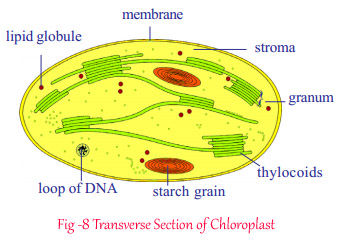
4. Explain the structure of chloroplast with a neatly labelled sketch.
-
Chloroplast is a membranous structure consisting of 3 membranes.
-
The third layer forms stacked sac like structures called granum.
-
The intermediatery fluid filled colourless portion is called stroma.
-
It is responsible for enzymatic reaction leading to the synthesis of glucose in plants.
-
Substances found in chloroplast, capture sunlight are called photosynthetic pigments.
-
Chlorophyll pigment contain one atom of magnesium.
-
Two major kinds of chlorophylls are associated with thyakoid membranes.
-
Chlorophyll-a is blue-green in colour and chlorophyll-b is yellow-green colour.
-
Around 250-400 pigments molecules are grouped as light harvesting complex units in granum.
-
Some of the events occur in chloroplast are :
a) Conversion of light energy to chemical energy.
b) Splitting of water molecule.
c) Reduction of carbondioxide to carbohydrates.
5. Write the experimental procedure to prove that oxygen is produced during
photosynthesis in the presence of light.
-
i) Hydrilla plants are used for this experiment they grow in water.
ii) Experiment to demonstrate the release of oxygen during photosynthesis.
Aim: To prove that oxygen is produced during photosynthesis by hydrilla funnel experiment.
Apparatus: Beaker with water, test tube, funnel, hydrilla twigs, glowing splinter.
Procedure: -
Arrange the apparatus as shown in the figure.
-
Place some water plant hydrilla in a beaker containing pond water, and cover these by a short stemmed funnel.
-
Invert a test – tube full of water over the stem of the funnel.
-
Ensure that the level of water in the beaker is above the level of stem of the inverted funnel.
-
Place the apparatus in the sun for at least 2 or 3 hours.
-
After sometime it is observed that gas bubbles come from the hydrilla plant. These bubbles are collected at the end of the test tube pushing the water into the beaker.
-
After sufficient gas is collected test – tube is taken out of the beaker carefully by closing it with thumb.
-
Observation: Test the gas in the test – tube by inserting a glowing incense stick which would burst into flames. This shows the presence of oxygen.
-
Result: This shows that oxygen is produced during photosynthesis.
-
Precautions:
-
Funnel should be smaller than the beaker.
-
Necessary care is to be taken while removing the test tube from the stem of the funnel.
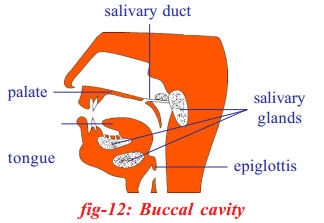
6. Describe the buccal cavity of human beings. (OR)
How is food masticated in buccal cavity?
-
The cavity or space in the mouth is called oral cavity or buccal cavity.
-
Teeth, tongue and openings of three salivary glands are present in buccal cavity
-
Incisors, canines, premolars and molars are the different types of teeth present in the mouth.
-
Tongue is muscular and pushes the food on to the teeth during mastication. It also helps in swallowing the food into oesophagus.
-
Three pairs of salivary glands present in the buccal cavity are parotid, sub-lingual and sub-maxillary glands.
-
Parotid glands are present near the ears. The other two pairs of glands open below the tongue through ducts.